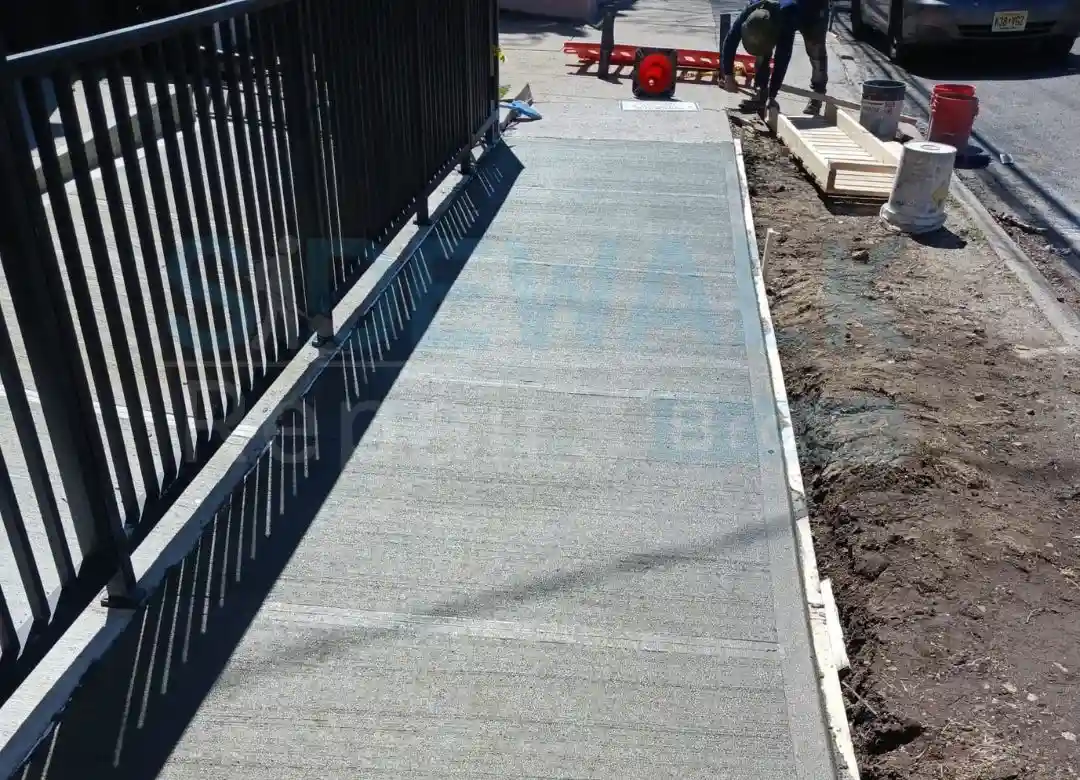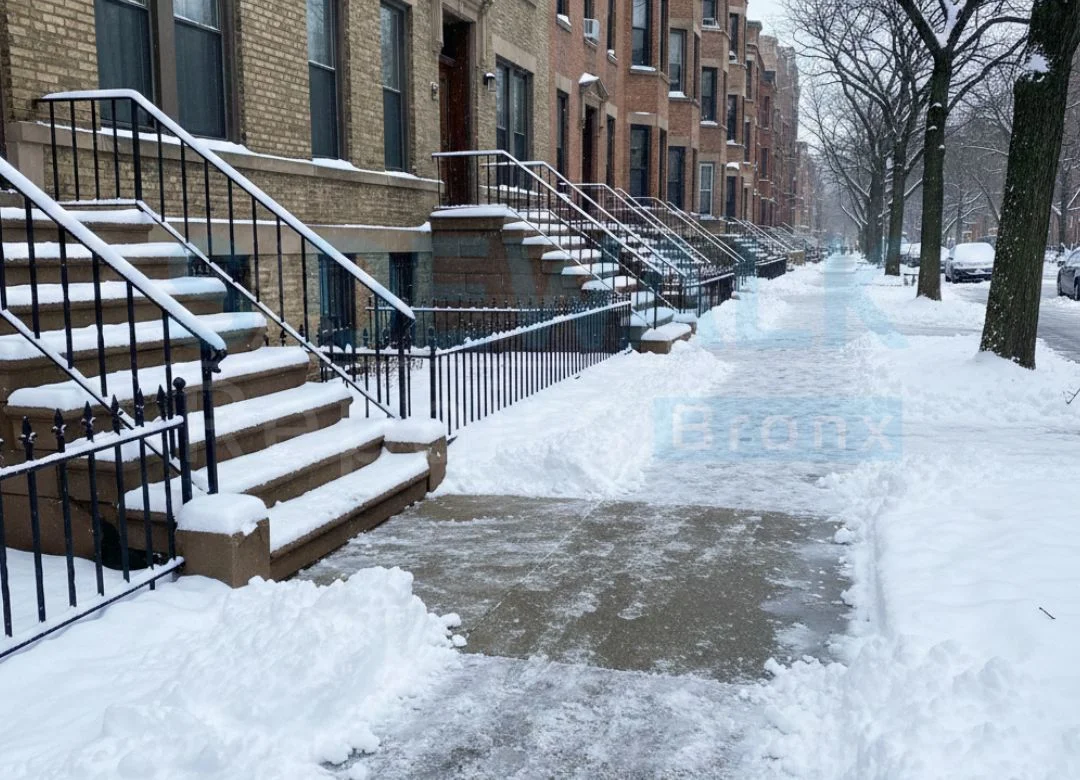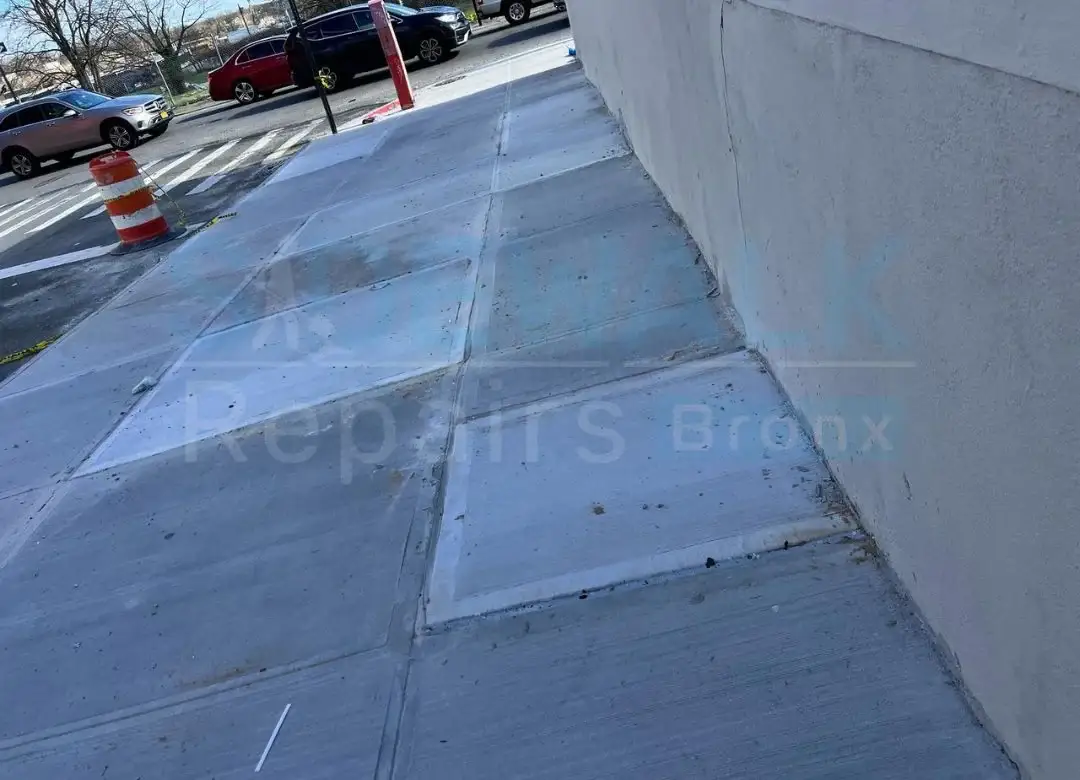

DOT inspectors do not care how old your sidewalk looks. They look for five specific signs: lifted flags, loose or broken pieces, holes, root damage and sinking. If you can spot those signs on your Bronx frontage before an inspector does, you can fix them on your schedule and budget instead of racing a 75-day deadline. Here is what each sign looks like, how to measure it, and what fixes it for good.
The 5 Signs at a Glance
| Sign | How to check | Can DOT cite it? | Usual fix |
|---|---|---|---|
| 1. Raised or lifted flag | Measure the height difference between flags | Yes, at 1/2 inch or more | Replace the flag |
| 2. Loose, rocking or broken flag | Step on each piece and look for movement | Yes | Replace the flag |
| 3. Holes and crumbling surface | Measure the width and depth of the hole | Yes, at 1 inch across and 1/2 inch deep | Replace the flag |
| 4. Tree roots lifting the sidewalk | Look for humps and cracks near street trees | Depends on property type | Replace with a Parks permit |
| 5. Sinking flags and standing water | Watch where water collects after rain | Yes, if it creates a height difference or bad slope | Regrade the base and replace |
Sign 1: A Flag Sits Higher Than the One Next to It
This is the most common reason Bronx owners get a violation. Under Section 19-152 of the NYC Administrative Code, a height difference of 1/2 inch or more between two adjacent flags is a substantial defect. It is also the classic trip hazard behind injury claims.
How to Measure It
Lay a straight edge, such as a level or a long piece of wood, across the joint on the lower flag. Measure the gap between the straight edge and the higher flag with a tape measure. Check every joint on your frontage, not only the ones that look bad. A lift often feels obvious underfoot long before it looks obvious.
What Fixes It
Grinding down the high edge or patching the low side will not clear a violation. DOT rules require a defective flag to be fully replaced. Our uneven sidewalk repair service replaces lifted flags to City standards. For more on why raised edges lead to claims, see our guide to trip hazards on Bronx sidewalks.
Sign 2: A Flag That Rocks, Sounds Hollow or Breaks Into Pieces
A crack by itself is not a violation. A crack that lets pieces of the flag move is. DOT treats a flag as defective when it is cracked so badly that pieces can be loosened or removed, when it rocks underfoot, or when there is a visible void underneath it.
How to Check
Walk slowly across each flag and step near the cracks. If a piece shifts, clicks or sounds hollow, the base under it has washed out or the flag has broken through. Look along the edges for gaps where you can see soil or empty space below the concrete.
What Fixes It
Loose or broken flags need full sidewalk flag replacement, with the base compacted underneath so the new flag does not settle. If you are not sure whether a crack is cosmetic, our guide to why Bronx sidewalks crack explains each crack type.
Sign 3: Holes, Spalling and a Crumbling Surface
Salt, freeze-thaw cycles and age wear the top layer of concrete away. At first it looks like flaking. Over time it becomes pits and holes. Under DOT's rules, a hole at least 1 inch across in every direction and 1/2 inch deep is a substantial defect.
How to Check
Look closely after rain, when water sits in pits and makes them easy to spot. Measure the width and depth of any hole with a ruler. Pay extra attention to the edge near the curb, where plowed slush and salt hit hardest in winter.
What Fixes It
Surface patches do not hold up and do not clear a violation, so a flag with defect-sized holes needs to be replaced. Shallow flaking that has not reached that size can be slowed with sealing and less salt. Our winter sidewalk care guide explains which de-icers damage concrete. For broken and spalled flags, see cracked sidewalk repair.
Sign 4: Tree Roots Lifting the Sidewalk
Street tree roots grow toward moisture under the pavement and push flags up as they thicken. On tree-lined Bronx blocks, root heave is one of the most common causes of lifted sidewalks.
Who Is Responsible Depends on Your Property
If you own a one-, two- or three-family home that is not used commercially, and the damage comes only from a City street tree, the City no longer issues violations for that damage. NYC Parks can repair it through its Trees and Sidewalks Program, but funding is limited and only severe damage is prioritized. If you hire a contractor instead, you can file a claim with the NYC Comptroller within 90 days of the repair.
Apartment buildings, co-ops, mixed-use and commercial properties do not qualify. Their owners are responsible for root damage like any other defect, and DOT can cite it.
What Fixes It
Roots of City trees cannot be cut, and any sidewalk work within 50 feet of a City tree needs a NYC Parks Tree Work Permit on top of the DOT permit. Our tree root sidewalk repair service handles both permits and repairs around the tree.
Sign 5: Sinking Flags and Standing Water
When the soil under a flag washes out or was never compacted properly, the flag sinks. A sunken flag creates the same height difference as a lifted one, and it also holds water, which freezes into a slip hazard in winter. DOT rules also treat improper slope, such as a flag that pitches toward the building instead of the curb, as a defect.
How to Check
Walk your sidewalk after a heavy rain. Puddles that sit for hours, flags tilting toward the building, and soil washing out near downspouts are all warning signs. Open or crumbling joints let even more water reach the soil, so check them too. Our guide to expansion joints in concrete sidewalks explains what DOT requires.
What Fixes It
Mudjacking and foam lifting can raise a slab, but they do not replace a defective flag, so they will not clear a DOT violation. The lasting fix is to fix the drainage, compact a new base and replace the flag at the correct slope.
How to Inspect Your Sidewalk in 15 Minutes
- Pick a dry day and walk the full frontage, from the property line to the curb.
- Check every joint for height differences with a straight edge and tape measure.
- Step on each flag near cracks and edges to feel for rocking or hollow spots.
- Measure any hole or crumbling patch for width and depth.
- Note any street tree within 50 feet and look for humps near it.
- Come back after rain to see where water collects.
- Take dated photos of everything you find, so you have a record of when you noticed it and what you did next.
Do this in spring and again in late fall. If you find a defect, fixing it before an inspection is almost always cheaper than fixing it under a deadline. See our breakdown of sidewalk repair cost in NYC, and if a notice has already arrived, read what happens if you ignore sidewalk repairs.
Found One of These Signs? Get a Free Bronx Sidewalk Inspection
Our licensed Bronx crew measures your sidewalk against DOT standards, tells you which flags could be cited, pulls the permits and replaces only what needs replacing. If you already have a notice, we handle sidewalk violation removal in the Bronx through final dismissal.
Call (718) 619-4844 | Get a Free Estimate
Frequently Asked Questions
How do I know if my sidewalk will get a DOT violation?
Check for the conditions DOT treats as substantial defects: a height difference of 1/2 inch or more between flags, loose or broken pieces, a rocking flag or void underneath, holes at least 1 inch across and 1/2 inch deep, missing flags and improper slope. If you find any of these, the flag can be cited.
Does NYC fine you for a damaged sidewalk?
Not under current law. DOT issues a violation with a 75-day repair deadline. If you miss it, the City can repair the sidewalk and bill you, and an unpaid bill can become a lien. A proposed bill, Int. 0195-2026, would add a penalty of up to $5,000 for most owners, but it has not passed.
Is a cracked sidewalk a violation in NYC?
Not by itself. DOT looks at whether the crack lets pieces loosen, creates a height difference or leaves a hole. A wide crack in a flag that is still solid and level may never be cited.
How do I measure a sidewalk trip hazard?
Lay a straight edge across the joint on the lower flag and measure the gap up to the higher flag. A difference of 1/2 inch or more is a substantial defect under NYC rules and a likely trip hazard.
Who pays for tree root damage to my Bronx sidewalk?
Owners of one-, two- and three-family homes not used commercially may qualify for the NYC Parks Trees and Sidewalks Program and are no longer cited for damage caused only by City trees. Apartment buildings, co-ops, mixed-use and commercial owners pay for root damage themselves.
Can I patch or grind a raised sidewalk flag myself?
You can, but it will not clear a DOT violation. NYC rules require a defective flag to be fully replaced. Any sidewalk work also needs a DOT permit before it starts, and a contractor doing the work must be DOT-registered.
How often should I inspect my sidewalk?
Twice a year, in spring after the freeze-thaw season and in late fall before it starts. Check again after heavy storms or any construction, delivery or tree work near your frontage.
How long does sidewalk repair take in the Bronx?
The concrete work itself usually takes a few days, but permits add lead time. A NYC Parks Tree Work Permit, needed near City trees, should be requested at least 20 business days before work starts. Getting a permit does not extend a 75-day violation deadline.