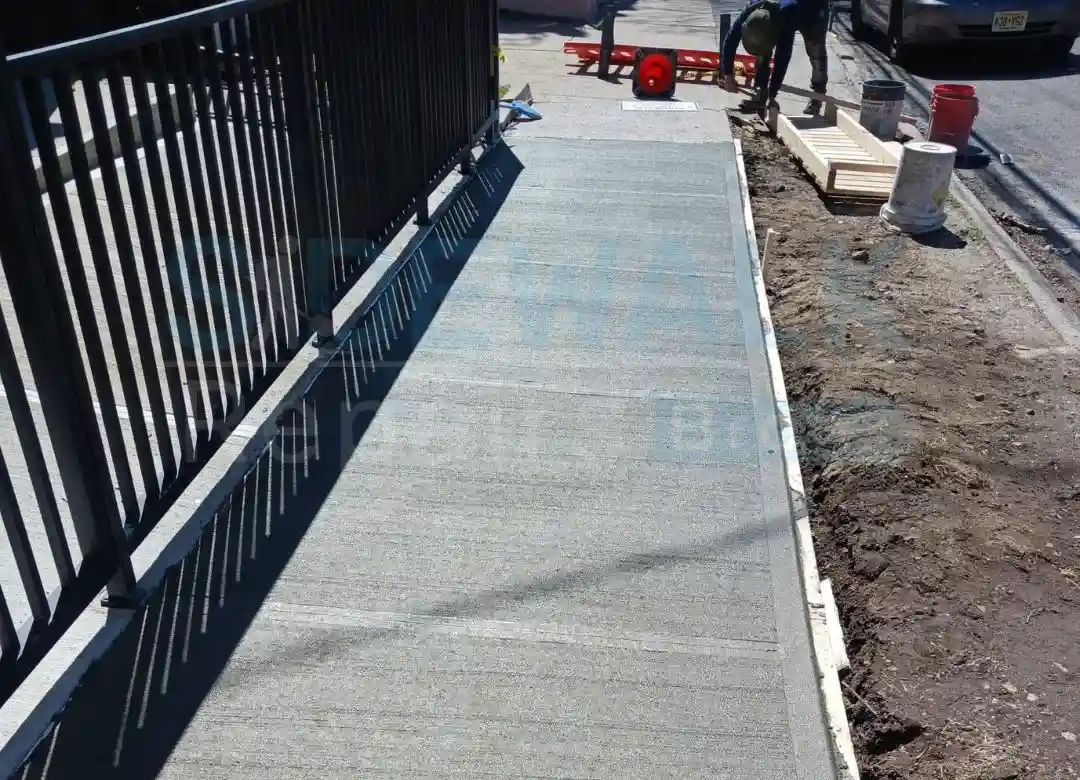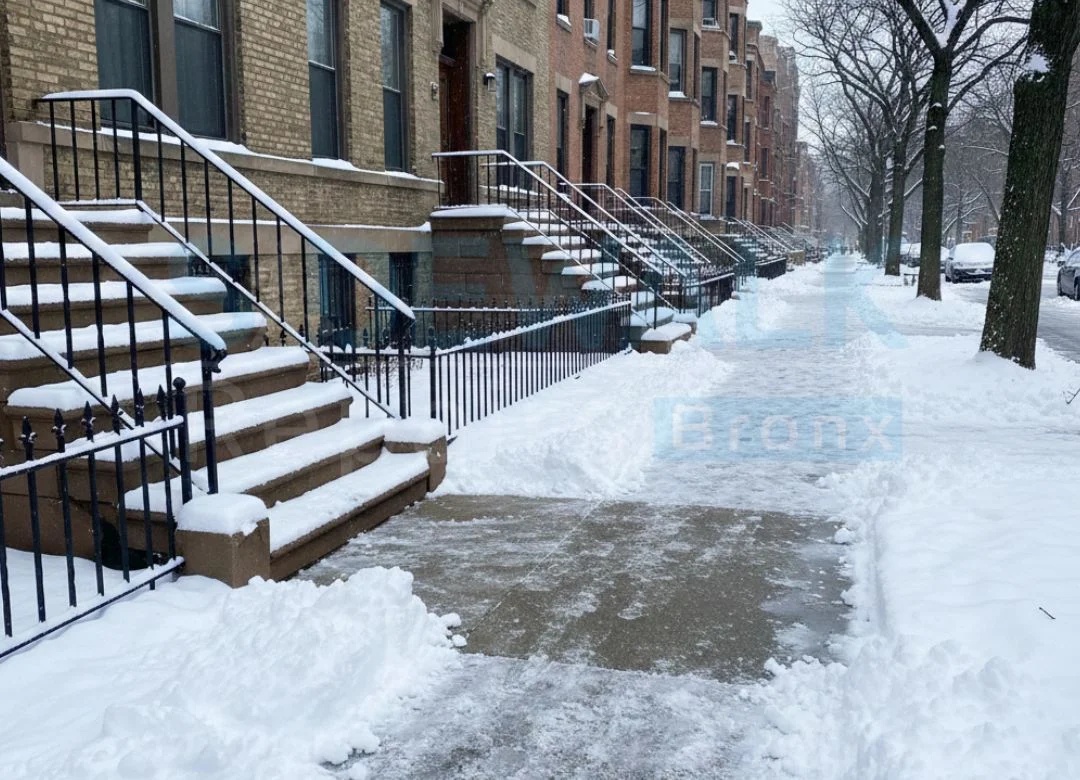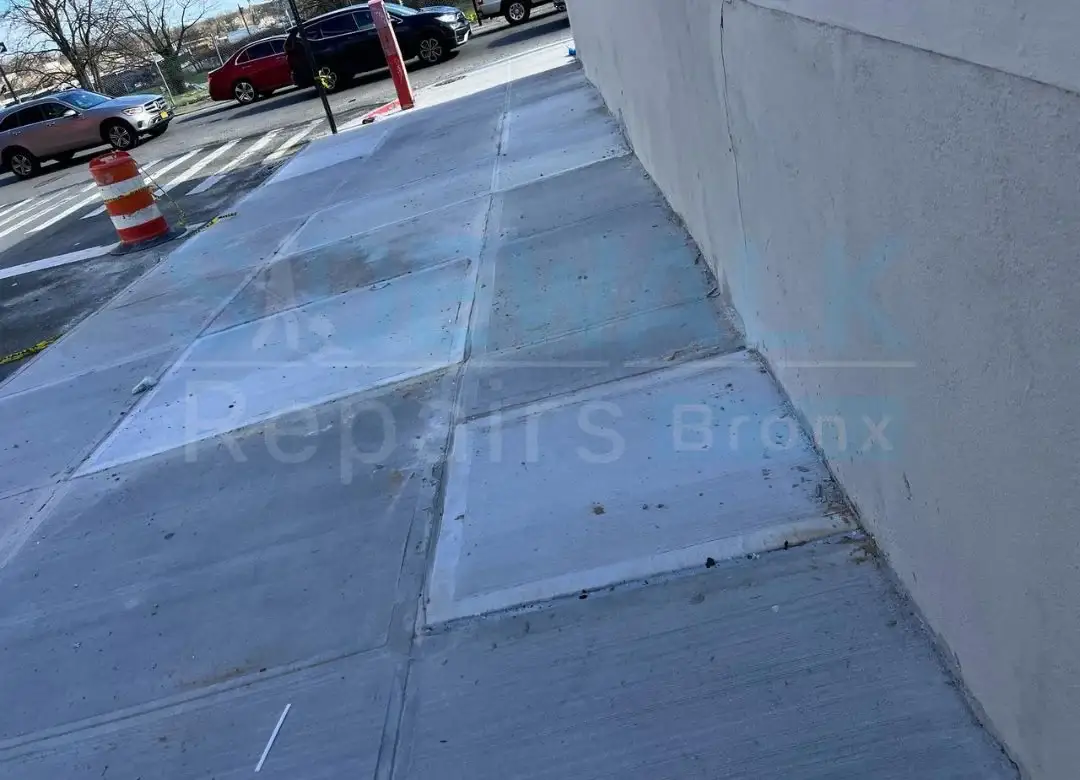
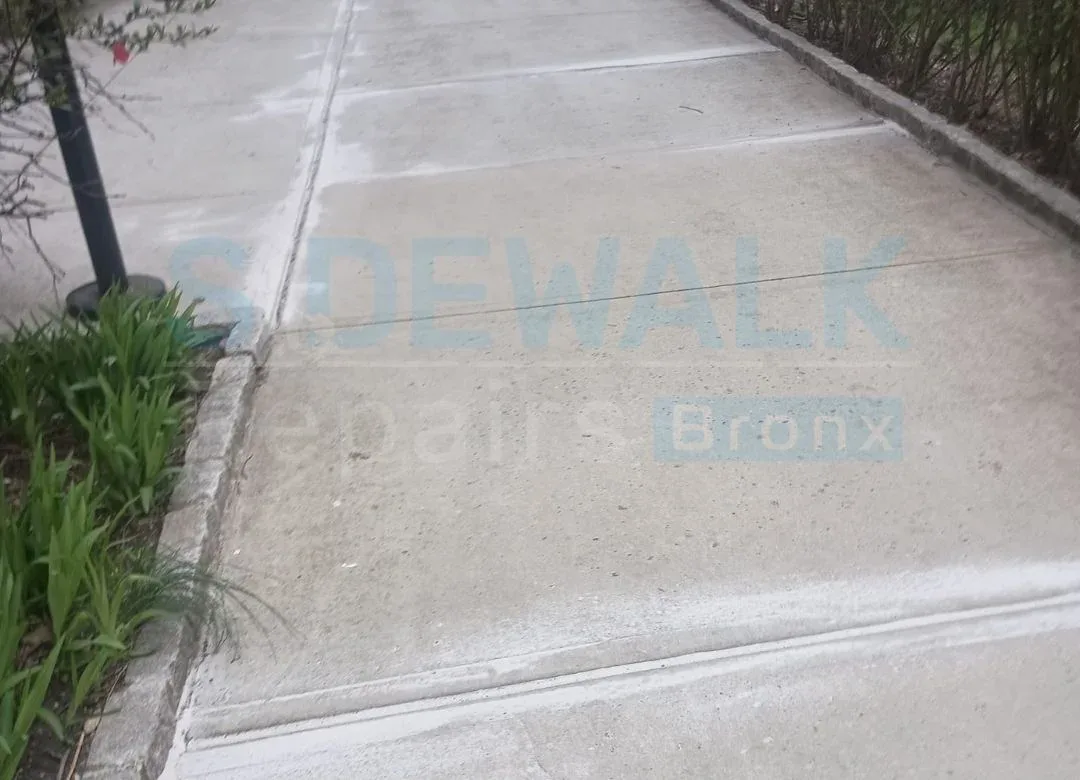
A small lift between two sidewalk flags looks harmless until someone trips on it. For Bronx property owners, the line is 1/2 inch: at that height difference, the flag counts as a defect, DOT can cite it, and most owners become liable for injuries. This guide shows how to measure an uneven sidewalk, who is responsible under NYC law, and when leveling works versus full replacement. For work on your property, see our uneven sidewalk repair service.
Why Sidewalk Flags Become Uneven
Flags become uneven when the ground under them moves. Soil that was never compacted properly settles over time and one flag sinks. Water from leaks, downspouts or poor drainage washes the base away. Frost pushes slabs up in winter and drops them again in spring. Street tree roots lift flags from below as they grow, which is common on the older tree-lined blocks of the East Bronx. In each case the concrete itself may still be solid, but the two sides of a joint no longer sit at the same height.
How to Measure an Uneven Sidewalk
What You Need
A straight board or level long enough to rest across the higher flag, and a tape measure or ruler marked in eighths of an inch. A phone photo with the ruler in frame is useful for your records.
Where to Measure
Lay the straightedge flat on the higher flag so it extends over the joint. Measure straight down from the bottom of the straightedge to the surface of the lower flag. Check along the whole joint, not just one spot, and record the highest reading. Do the same for any hole or broken area: measure its width in every direction and its depth.
What the Number Means
- Under 1/2 inch: not a defect under NYC rules yet, but worth watching, especially before winter.
- 1/2 inch or more between flags: a trip hazard and a substantial defect DOT can cite.
- A hole 1 inch or wider in every direction and 1/2 inch or deeper: also a substantial defect, even if the flags are level.
Who Is Liable When Someone Trips
Apartment Buildings, Co-ops and Commercial Properties
Under NYC Administrative Code 7-210, the owner of the property next to the sidewalk must keep it reasonably safe and can be held liable for injuries caused by failing to repair defective flags. That covers landlords, co-ops, condos and commercial owners, from apartment buildings on the Grand Concourse to storefronts on Fordham Road. The duty cannot be handed off to a tenant, managing agent or contractor, so an uneven flag in front of a Bronx apartment building is the owner's risk.
Owner-Occupied 1 to 3 Family Homes
This matters in neighborhoods like Throggs Neck, Morris Park and Van Nest, where many properties are 1 and 2 family homes. The law exempts 1, 2 and 3 family homes that are owner-occupied and used only as a residence. For those homes, the City generally carries the injury liability instead. The exemption is lost if the owner lives elsewhere or any part of the building has a business use, and a homeowner can still be responsible for a hazard they created, including a poor repair. Even when exempt, a DOT violation can still apply to damage that is not caused only by City tree roots.
Ways to Level an Uneven Sidewalk
| Method | How it works | Best for | Limits |
|---|---|---|---|
| Concrete grinding | Grinds down the raised edge so the joint is flush | Small lifts on solid, intact flags | Temporary if roots or frost keep pushing the flag up |
| Mudjacking | Pumps a cement grout under a sunken flag to raise it | Sunken flags that are still in one piece | Larger drill holes; heavy grout can settle again on weak soil |
| Polyurethane foam lifting | Injects expanding foam under a sunken flag | Sunken flags where fast curing and small holes matter | Usually costs more than mudjacking |
| Full flag replacement | Removes the flag, fixes the base and pours new concrete | Cracked, broken, root-lifted or DOT-cited flags | Needs a DOT permit for larger work or any violation repair |
Concrete Grinding
Grinding shaves the high side of a joint down to meet the lower flag. It is quick and leaves the flag in place, which makes it a good option for small lifts on concrete that is otherwise sound. It does not fix the cause, so if a tree root or frost lifted the flag, the lift usually comes back.
Mudjacking
Mudjacking raises a sunken flag by pumping a mix of cement, sand and water underneath it through drilled holes. It works when the flag is still in one piece and the problem is lost support below. The grout is heavy, so on soft or wet soil the flag can sink again over time.
Polyurethane Foam Lifting
Foam lifting does the same job as mudjacking with a lightweight expanding foam injected through smaller holes. It cures quickly and resists water, but it usually costs more per flag than mudjacking.
Full Flag Replacement
Replacement removes the damaged flag, corrects the base and pours a new flag to DOT specifications. It is the only method that solves a cracked or broken flag, and it is how a cited defect is normally corrected, since NYC rules call for defective flags to be fully replaced.
Why Polymeric Sand and Concrete Overlays Don't Fit Bronx Sidewalks
Polymeric sand is made for the joints between pavers, not for concrete sidewalk flags. A thin concrete overlay or patch spread over a low spot tends to crack and flake under Bronx winters, freeze-thaw cycles and salt, and it does not correct a defective flag. Neither is a real fix for an uneven concrete sidewalk.
Leveling or Replacement: How to Decide
When Leveling Makes Sense
Leveling is a good choice when the flag is intact, the lift or dip is small, the cause is settled soil rather than an active tree root, and there is no open DOT violation on the property.
When Replacement Is the Only Option
Replace the flag when DOT has already cited it, when it is cracked into loose pieces, when there is a void or the flag rocks, or when a street tree root is lifting it. Repairs near a City tree need a NYC Parks Tree Work Permit, and roots cannot be cut without Parks approval.
What Affects the Cost
The price depends on the method, the number of flags, access and the condition of the base below. Grinding a few joints costs far less than replacing flags, and permits add to any job that needs one. Our guide to sidewalk repair costs breaks down the numbers.
Get an Uneven Sidewalk Measured
Not sure if a lift in front of your Bronx property crosses the 1/2 inch line? Our team measures every joint against DOT standards and tells you whether grinding, lifting or full flag replacement is the right call. Contact us for a free estimate.
Uneven Sidewalk FAQs
How uneven does a sidewalk have to be to get a DOT violation?
A height difference of 1/2 inch or more between adjacent flags counts as a trip hazard. A hole at least 1 inch across in every direction and 1/2 inch deep also qualifies.
Can I grind down a raised sidewalk flag?
Yes, for small lifts on an intact flag that has not been cited. If a tree root or frost caused the lift, grinding is usually temporary because the flag keeps moving.
Does leveling a flag clear a DOT violation?
Do not count on it. NYC rules call for defective flags to be fully replaced, so a cited flag is normally corrected by replacement with a DOT permit.
Is mudjacking or foam lifting better?
Both raise sunken flags that are still in one piece. Mudjacking usually costs less, while foam uses smaller holes, cures faster and weighs less on weak soil.
Who is liable if someone trips on an uneven sidewalk in the Bronx?
Usually the owner of the property next to the sidewalk, under the same NYC law that applies in every borough. Owner-occupied 1 to 3 family homes used only as a residence are the main exception.
Can I level a sidewalk lifted by tree roots?
Not permanently. The roots keep growing, and they cannot be cut without NYC Parks approval, so root-lifted flags are usually replaced under a Parks Tree Work Permit.
Do I need a permit to level an uneven sidewalk?
You need a DOT permit for any sidewalk work over 25 square feet, or for work of any size done to remove a violation. If a contractor does the work, the contractor must be DOT-registered and pull the permit.
Can I fill gaps between sidewalk flags with polymeric sand?
No. Polymeric sand is designed for paver joints, not concrete sidewalks, and it will not correct a height difference between flags.