If you own property in the Bronx, or anywhere else in New York City, and ignore a DOT sidewalk violation, the City can repair your sidewalk itself and send you the bill. Leave that bill unpaid and it can become a lien on your property. You also stay liable if someone trips on the defect. Here is exactly how the process works, what it costs you to wait, and how to clear a violation before it gets that far.
What Happens After You Get a DOT Sidewalk Violation
A DOT sidewalk violation does not come with a fine under current law. It starts a deadline. When an inspector finds a defect, DOT issues a Notice of Sidewalk Violation and gives you 75 days to fix it. If you miss that window, the consequences stack up in this order:
| Stage | When | What happens |
|---|---|---|
| Notice issued | Day 0 | The clock starts when you receive the notice by certified mail, or when it is posted on the property if delivery fails. |
| Repair deadline | Day 75 | You must finish the repair with a licensed contractor and the right permit. |
| City repair | After day 75 | DOT may send its own contractor to do the work. You have no say in scheduling or price. |
| Bill | After the City repair | The cost is billed to you through the Department of Finance. |
| Interest | 90 days after the bill | Interest starts if the bill is still unpaid. |
| Lien | If it stays unpaid | The debt can become a lien on the property, which can complicate a sale or refinance. |
The 75-Day Deadline and When It Starts
The 75 days run from the date you receive the notice, not the date you read it. Getting a sidewalk permit does not pause or extend the clock. If you get your permit inside the 75 days, you generally have 10 days after that to finish the work, so leaving it until week ten is risky.
Immediate Danger Notices: The 10-Day Deadline
Some defects skip the 75-day track. If DOT has written notice of a defect and decides it poses an immediate danger to the public, it can order the repair within 10 days. That leaves almost no time to find a contractor and pull permits, which is why it pays to fix serious trip hazards before an inspector sees them.
What Counts as a Sidewalk Defect Under NYC Rules
NYC does not cite every crack. Section 19-152 of the Administrative Code lists the conditions DOT treats as substantial defects. The most common ones on Bronx blocks are:
- Trip hazards where one flag sits higher than the next
- Broken or shattered flags
- Flags that are sunken, raised or tilting toward the property line
- Missing concrete, holes and deep spalling
- Hardware or patchwork that sits above or below the surrounding surface
The Half-Inch Trip Hazard Rule
A vertical difference of half an inch or more between two adjacent flags counts as a substantial defect. Half an inch is about the diameter of a AA battery. Tree roots and freeze-thaw cycles can push a flag past that line in a single winter.
Why Patching Does Not Clear a Violation
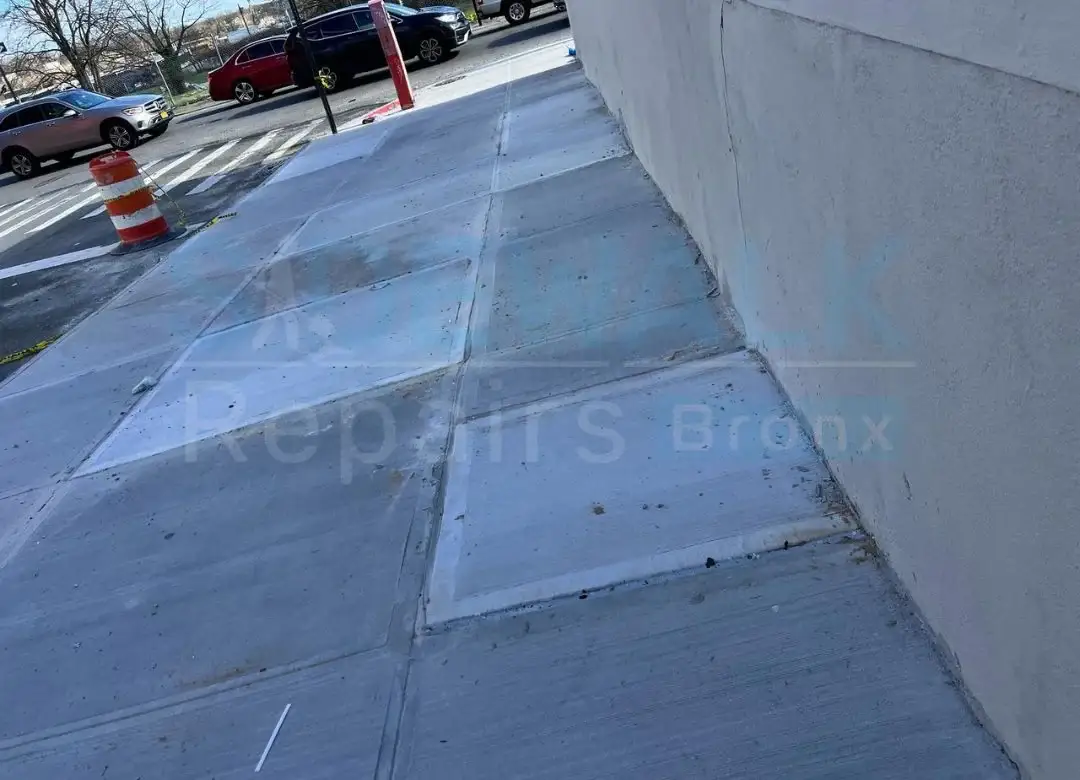
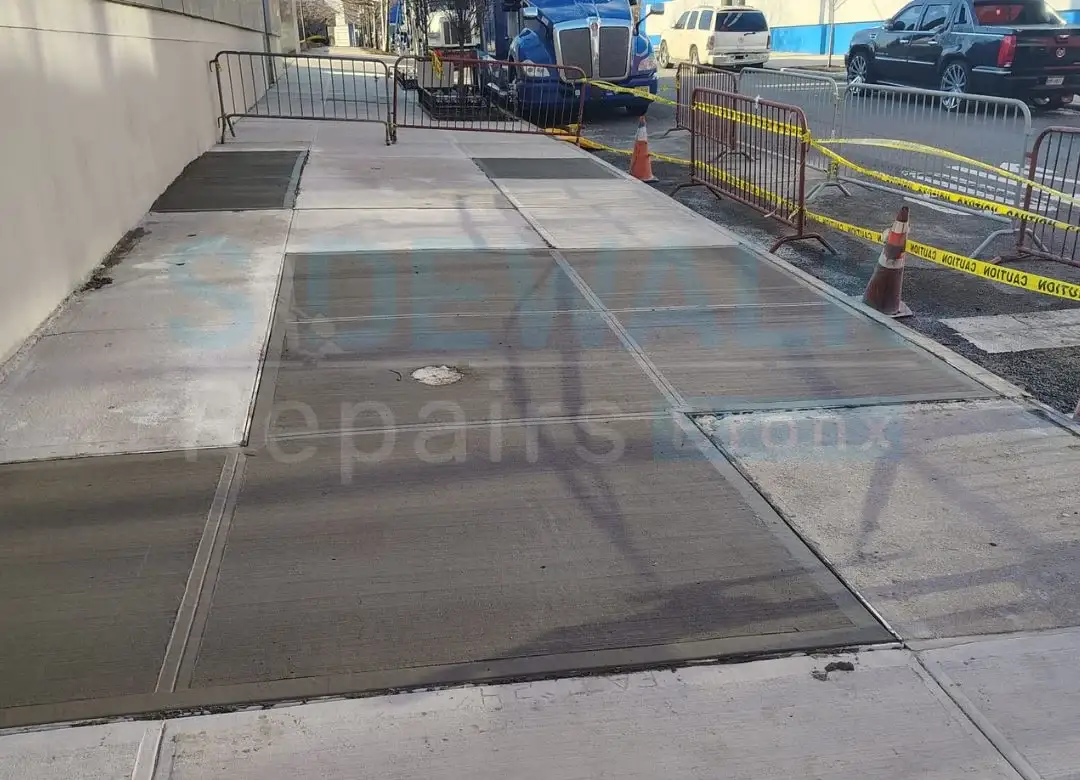
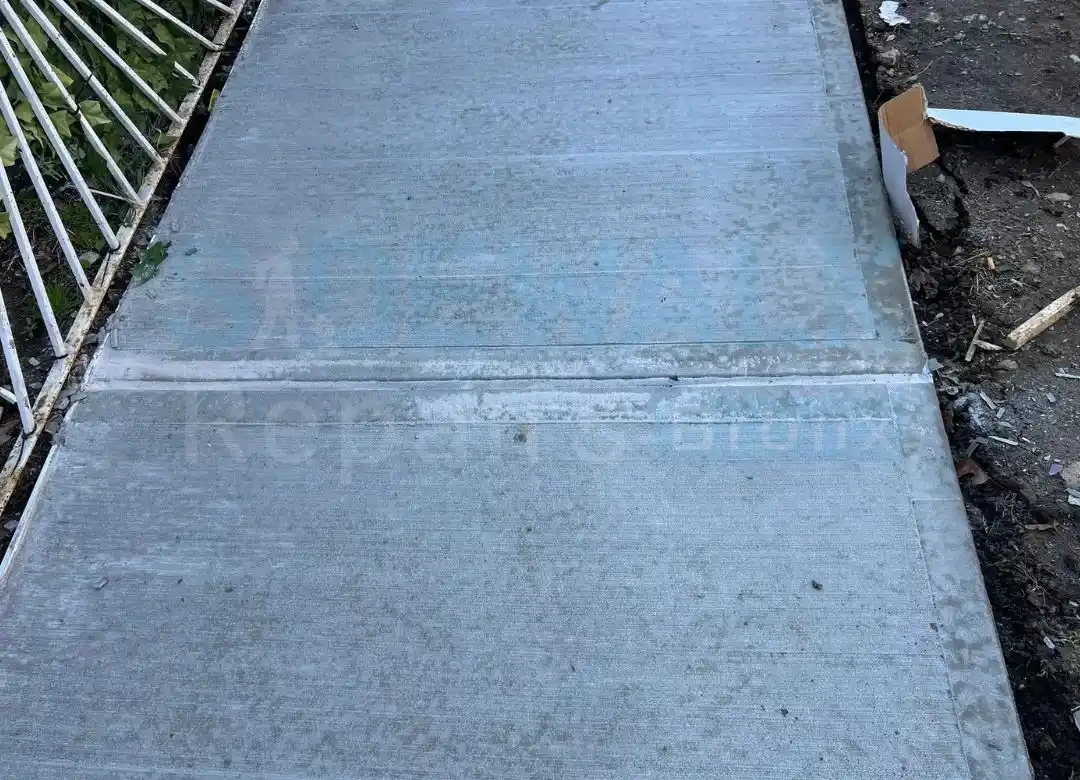
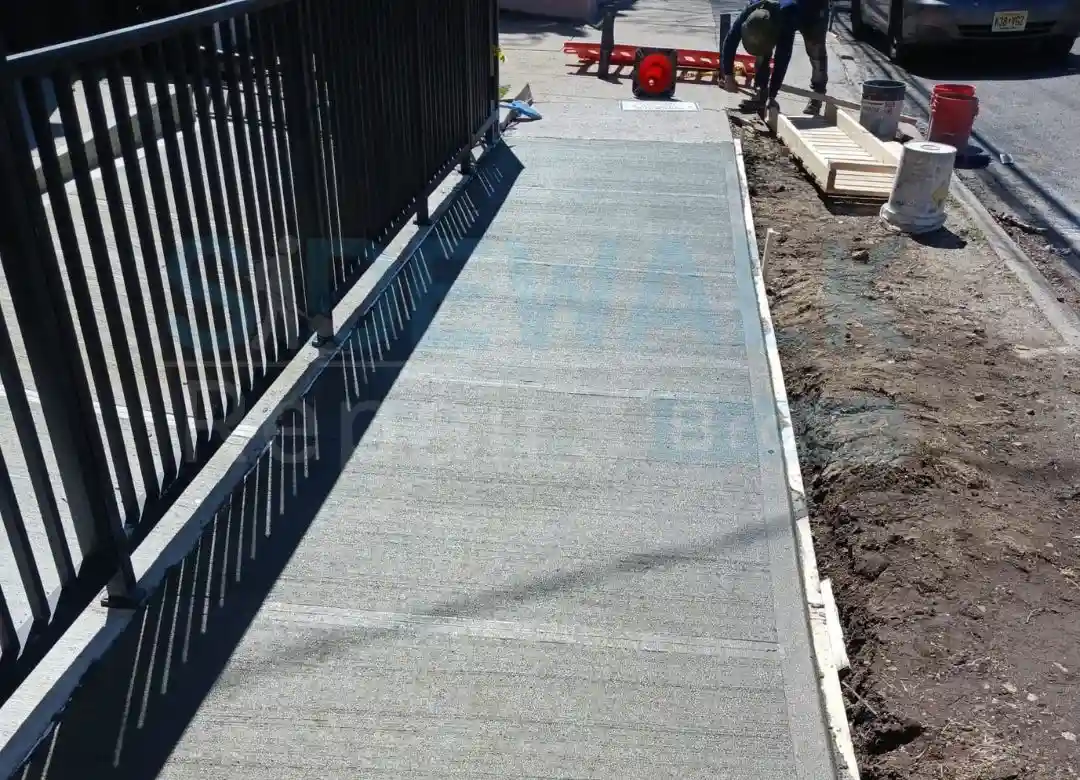
DOT rules require a defective flag to be fully replaced, not patched. Grinding a lip down or filling a gap with patching compound may look fine, but it will not get the violation dismissed. Budget for full sidewalk flag replacement from the start, and if your problem is a raised edge, read our guide to uneven sidewalk repair.
Who Is Liable If Someone Trips on Your Sidewalk
For most NYC property owners, an injury on the sidewalk in front of the building is the owner's legal problem, not the City's. Sidewalk falls are common: in fiscal year 2023, New Yorkers filed 2,350 personal injury claims over sidewalk conditions against the City alone, according to the NYC Comptroller's annual claims report. An open violation on your record makes it harder to argue you did not know about the hazard. For more on how small height differences turn into claims, see our guide to trip hazards on Bronx sidewalks.
Section 7-210: Which Owners Carry Injury Liability
Since 2003, Section 7-210 of the Administrative Code has made most owners of property next to a sidewalk responsible for keeping it reasonably safe. That covers apartment buildings, mixed-use buildings with stores on the ground floor, commercial property, vacant lots, and the co-op and condo boards that run larger buildings.
The 1 to 3 Family Owner-Occupied Exemption
Owner-occupied one-, two- and three-family homes used only as residences are exempt from that injury liability. The exemption is narrow. A house with a store or office, or one where the owner does not live, will likely fall outside it. Exempt owners still have to fix their sidewalk when DOT issues a violation, and still get the bill if the City does the work.
DOT Repair vs Hiring Your Own Contractor
Letting the City do the work can look like the easy option. In practice you give up control over timing, price and how much of the sidewalk gets replaced.
| Factor | City repairs it | You hire a licensed contractor |
|---|---|---|
| Price | Set by the City, billed after the fact | Quoted in writing before work starts |
| Timing | DOT's schedule, not yours | You pick the date |
| Scope | DOT decides how many flags to replace | You see the defect list and can fix nearby issues at the same time |
| Permits | Handled by the City | Handled by your contractor |
| Violation dismissal | Handled by the City | Your contractor requests the dismissal inspection |
| Risk of a lien | Yes, if the bill goes unpaid | None, you pay your contractor directly |
For typical price ranges by job size, see our breakdown of sidewalk repair cost in NYC.
Could NYC Start Fining Owners? The Proposed $5,000 Penalty
A bill now before the City Council would add a fine on top of the repair bill. Int. 0195-2026, introduced on January 29, 2026, would let DOT charge a civil penalty of up to $5,000 when a covered owner misses the 75-day or 10-day deadline. It could also apply the moment an immediate-danger notice is issued if DOT decides the owner knew or should have known about the hazard.
The same owner-occupied 1 to 3 family homes that are exempt from Section 7-210 would be exempt here too. As of October 2026 the bill is still in the Committee on Transportation and Infrastructure and has not been voted on. You can follow its status on intro.nyc. Either way, the safest position is the same: no open violation to penalize.
Why Bronx Repairs Take Longer Than 75 Days Suggests
Seventy-five days sounds like plenty. On a typical Bronx block, paperwork eats a large share of it before any concrete comes out:
- Finding a licensed, insured sidewalk contractor and getting a written quote
- Pulling the DOT sidewalk permit, which does not extend your deadline
- Getting a NYC Parks Tree Work Permit if a City tree is nearby
- Scheduling the pour around weather, since concrete needs warm, dry conditions to cure
- Requesting the inspection that gets the violation dismissed
Tree Work Permits on Tree-Lined Blocks
Any sidewalk work within 50 feet of a City street tree needs a Tree Work Permit from NYC Parks. Parks asks for construction-related applications at least 20 business days before work starts, and cutting tree roots is not allowed. On streets like the Grand Concourse or Pelham Parkway, that alone can take a month out of your 75 days. Our tree root sidewalk repair page covers root-damaged sidewalks and the extra steps they involve.
Corner Lots and Through Lots
Corner properties and through lots often have more than one frontage, and each may need its own permit. Start early if your building fronts two streets. Our guide to NYC sidewalk permit requirements covers which permits apply.
Got a Sidewalk Violation? Get It Dismissed Before Day 75
Our licensed Bronx crew inspects the defect, pulls the permits, replaces the flags to DOT standards and handles sidewalk violation removal in the Bronx through final dismissal.
Call (718) 619-4844 | Get a Free Estimate
Frequently Asked Questions
How long do I have to fix a sidewalk violation in NYC?
You have 75 days from the date you receive the Notice of Sidewalk Violation. If certified mail delivery fails, the clock starts when the notice is posted on the property. An immediate-danger notice is different: it gives you only 10 days. Plan for permits and scheduling inside that window, because neither extends it.
Do these sidewalk rules apply to Bronx property owners?
Yes. Sidewalk rules are set citywide, so Bronx owners follow the same 75-day deadline, Section 7-210 liability and permit rules as the rest of NYC. The difference is often the block itself. Many Bronx streets are tree-lined, so a Parks Tree Work Permit can add about 20 business days. Start lining up a contractor as soon as the notice arrives.
Does NYC fine you for a sidewalk violation?
Not under current law. Missing the deadline lets DOT repair the sidewalk and bill you instead. A proposed bill, Int. 0195-2026, would add a civil penalty of up to $5,000 for most owners who miss DOT deadlines. As of October 2026 it is still in committee and has not passed.
What happens if the City repairs my sidewalk?
DOT sends its own contractor and bills you through the Department of Finance. You do not choose the date, the price or how many flags are replaced. You generally have 90 days to pay before interest starts, and an unpaid bill can become a lien on the property.
Can an unpaid sidewalk repair bill become a lien?
Yes. If the City's repair bill stays unpaid, it can be placed as a lien against the property. A lien can delay or complicate a sale or a refinance until it is cleared. Fixing the sidewalk yourself before day 75 avoids the City bill entirely.
Am I liable if someone trips on my sidewalk?
Most likely yes, unless you own an owner-occupied one-, two- or three-family home used only as a residence. Under Section 7-210 of the Administrative Code, most other owners are responsible for keeping the abutting sidewalk reasonably safe. An open violation can make it harder to show you did not know about the hazard.
Does getting a permit extend the 75-day deadline?
No. A sidewalk permit does not pause or extend the 75-day compliance period. If you obtain the permit within the 75 days, you generally have 10 days afterward to finish the work. On blocks with City trees, a Parks Tree Work Permit adds about 20 business days of lead time.
How do I get a sidewalk violation dismissed?
Have a licensed contractor replace the defective flags to DOT standards under a valid permit. After the work is done, a dismissal inspection is requested from DOT. Once DOT confirms the repair meets its rules, the violation is dismissed. Keep the permit, invoice and photos as your record.
Are 1 to 3 family homes exempt from sidewalk repairs?
They are exempt from injury liability and from the proposed $5,000 penalty, but not from repairs. If DOT cites your sidewalk, you still have to fix it within 75 days. If you do not, the City can repair it and bill you, just like any other owner.