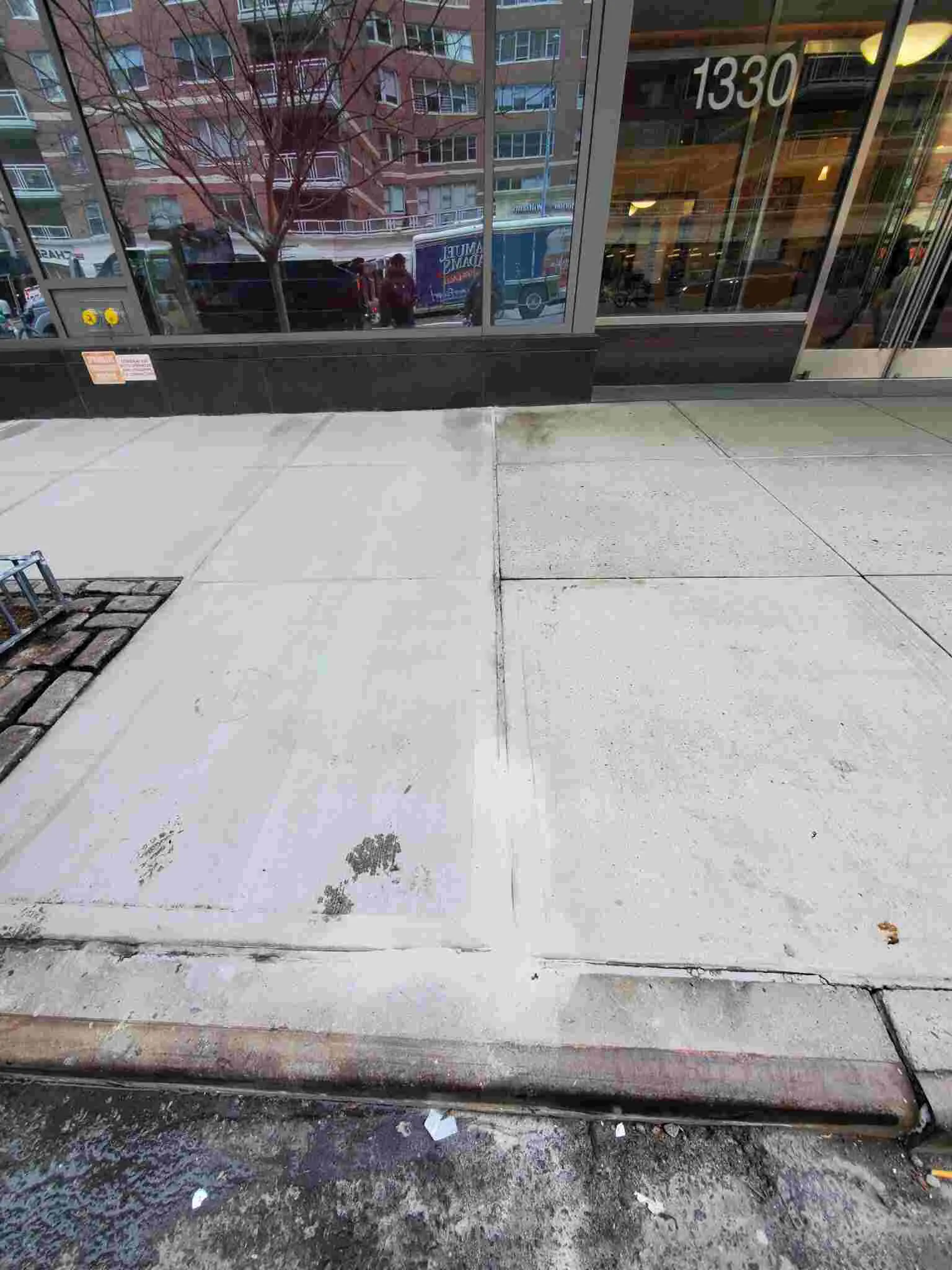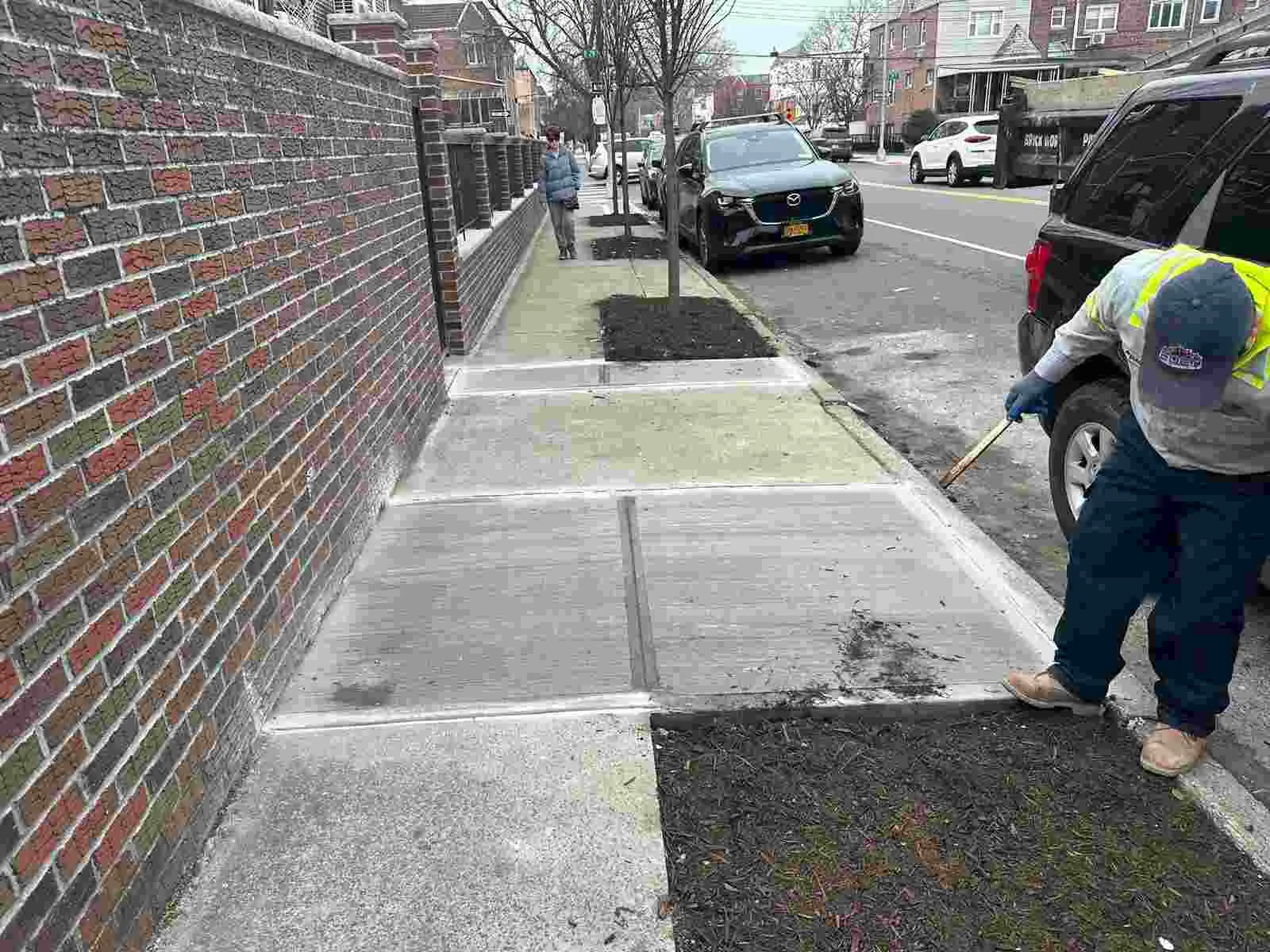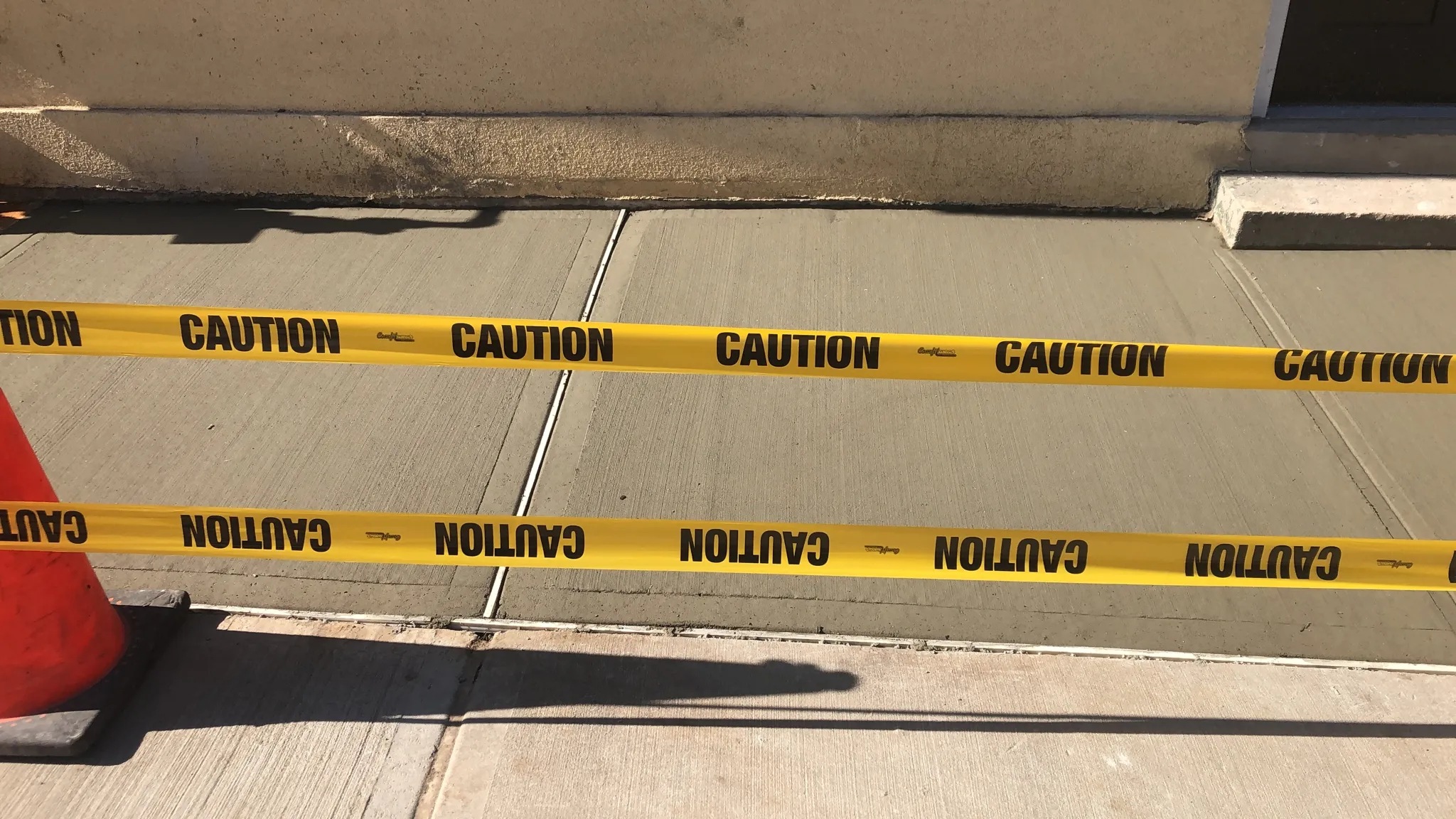
- Concrete thickness
- 7" through driveways and corner quadrants, not the 4" used for sidewalk
- Foundation
- 6" beneath the slab
- Drainage
- Must fall toward the curb, 1"-3" in 5'; ponding flags are a listed defect
- Partial repairs
- Patching of individual flags is not permitted by DOT
- Permit
- Apron is public right of way. DOT permitted work
- Changing vehicle access?
- A new or widened curb cut is a separate DOB approval
Your apron is the only sidewalk you drive on
The apron is the stretch between your property line and the roadway that vehicles cross to reach a driveway, garage or parking pad. It is still sidewalk in the legal sense. It sits in the public right of way, it is your responsibility to maintain, and it is inspected against the same defect list as the rest of your frontage.
What it is not is ordinary flatwork. Standard sidewalk is a 4-inch concrete course. Through driveways and corner quadrants the specification is 7 inches. That is a 75% increase in section, and it exists because a car crossing a slab imposes loads a pedestrian never will.
When DOT explains how to estimate a City-performed repair, it directs owners to use the 7-inch concrete rate for any driveway area and the 4-inch rate elsewhere. The City's own cost formula distinguishes the two, which is a reasonable benchmark for what your apron should have been built to.
How to tell an apron was built too thin
Under-specified aprons fail in a recognisable pattern, and once you know it you can usually diagnose your own from the sidewalk:
- Cracking that follows the wheel path rather than the joint layout: two roughly parallel lines about a track-width apart.
- Movement under load: the slab shifts very slightly as a car rolls over it, or you hear it move.
- Break-up at the curb line where the apron meets the dropped curb and the section is thinnest.
- Corner spalling at the edges of the crossing, where the slab is unsupported and taking impact.
- Ponding at the garage: the apron has settled enough to reverse the fall, so water runs back toward the building instead of to the curb.
Why patching an apron is a false economy
Two reasons, one regulatory and one physical. DOT does not permit patching of individual flags, and less-than-full-depth repair is defined as patchwork: itself a listed defect under § 19-152.
Physically, a partial repair puts a cold joint exactly where the load is highest. The new material and the old are not bonded into a single structural slab, so the wheel load works the joint every time you drive across it. Apron patches typically fail at the patch edge within a couple of seasons.
The repair we build
- Establish why it failedThickness, base, drainage or a curb that has dropped, usually more than one. We check before quoting so the same failure is not rebuilt.
- PermitDOT permit pulled for right-of-way work; if the crossing itself is changing, the DOB curb cut route applies first.
- Full-depth removalThe apron comes out whole rather than in patches.
- Rebuild the base properlySix-inch foundation, compacted: a 7-inch slab on a soft base is still going to move.
- Pour at 7 inchesTo the section NYC uses for driveway areas, with joints placed so the slab can move without cracking.
- Set the drainageFall toward the curb inside the 1-3 inches per 5 feet window, so water leaves the apron rather than standing against your garage.
- Cure and protectBarricaded and kept off. Vehicle loading waits considerably longer than foot traffic, and we will tell you the hold time for your specific pour.
Bronx aprons and the conversion problem
A recurring situation on Bronx blocks: a front yard or side alley gets used for parking, vehicles cross a stretch of plain sidewalk daily, and nothing about that crossing was ever built as one. There is no dropped curb, no 7-inch section, no thickened base: just 4-inch pedestrian flatwork taking wheel loads.
That frontage cracks, then rocks, then becomes a trip hazard at the half-inch threshold that makes it citable. If you are in that position, the durable fix and the compliant fix are the same thing: build the crossing as a crossing, and where vehicle access needs to be formalised, do the curb cut properly.